
Link Building · 12 min read
How Much Does Link Building Cost in 2026? (Real Numbers, No Fog)
Published · Updated · by Uchhash Akanda
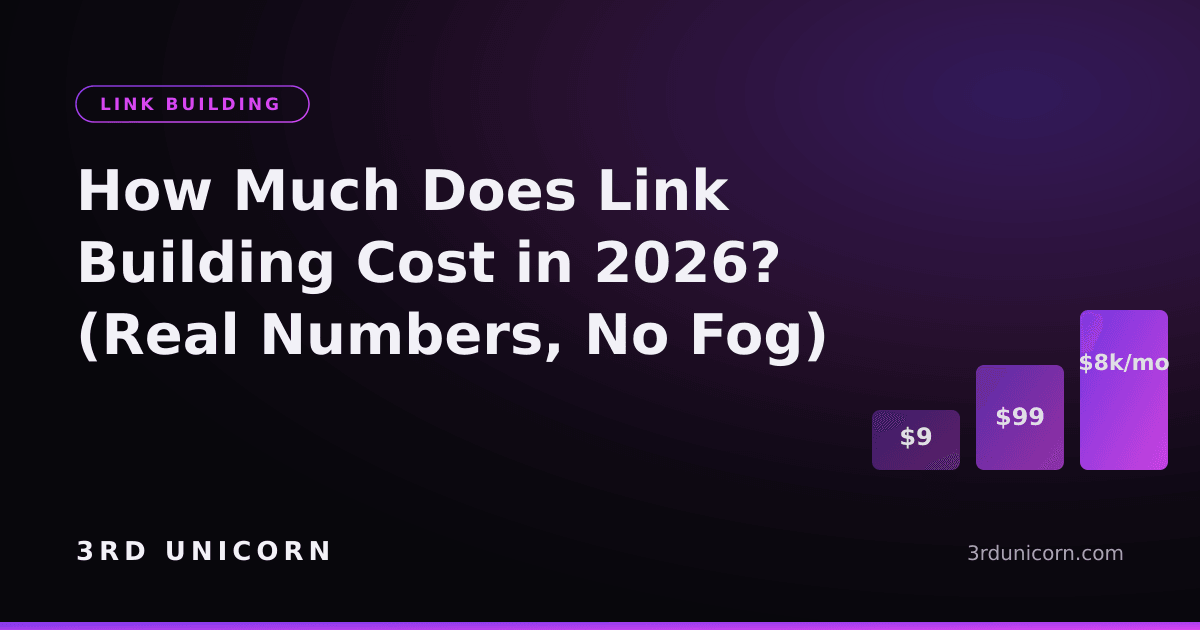
Ask “how much does link building cost” and you’ll get answers spanning three orders of magnitude — $9 marketplace links, $670 productized packs, $8,000-a-month boutique retainers — usually from people selling one of them. The fog isn’t accidental: opacity is the margin. So here are the real numbers across the whole market, the math that actually matters (cost per surviving link, not cost per link), and a budget framework by business stage. Our own rates appear alongside everyone else’s, because a pricing article that hides its author’s prices is an ad.
The 2026 price landscape, end to end
Marketplace links: $9–$83+ per link. The big self-serve marketplaces list tens of thousands of sites with instant checkout. The median listing sits in the $30–$80 band; the floor scrapes single digits. What you’re buying at this tier is a URL on a site you’ve never vetted, in content you didn’t see before purchase, from inventory whose economics only work if the vetting never happens. Some legitimate small publishers do live here — finding them is a needle-and-haystack exercise that costs you the analyst time the price tag saved.
Productized packs: ~$670 for 5 links at DR20–30. The “done-for-you” middle tier: standardized packs, DR-banded pricing, stock content included. Typical market pricing works out to $130–$135 per link for DR20–30 inventory — modest sites, template content, hit-rate quality. The convenience is real; the quality distribution is wide, because pack sellers make margin on volume, and volume is the enemy of vetting.
Boutique link building agencies: $8,000+/month, often with 12-month contracts. At the top of the dedicated-link market, boutique shops charge five figures a month, commonly gated behind long commitments. The good ones genuinely earn it — real digital PR, real relationships, links you couldn’t buy à la carte. The problem isn’t the quality; it’s the entry ticket: $96,000+ committed before you’ve seen a quarter of results, which prices out everyone but funded companies.
US full-service agencies: $2,500–$7,500/month. Link building bundled inside general SEO retainers. Typically 4–8 placements a month ride along with content and technical work — decent economics if the links are genuinely editorial, which varies enormously and is rarely itemized enough to check.
For calibration, our published rates sit deliberately between the pack tier and the boutique tier: single editorial placements from $99, a 5-link starter pack at $449, monthly campaigns from $999 — at DR50+ with live-traffic vetting, written content, and replacement guarantees. Why that’s possible at that price is a cost-base story we tell openly on the pricing page; why it matters is the survival math below.
Why the “same” DR50 link costs $9 or $349
Because DR is the packaging, not the product. Two listings can carry identical scores and be entirely different objects. What actually costs money in a legitimate placement:
- Vetting: ~30–60 minutes of skilled analysis per accepted site. Live-traffic verification, keyword-market match, outbound-link forensics, update-survival history — the auditor’s checklist exists because most inventory fails it. A seller who vets rejects most of what they see; the rejects are the cost the $9 link never pays.
- Content: $30–$150 of real writing. An 800–1,200 word article a human editor will accept, in the publication’s voice, with your link placed where it makes editorial sense. Cheap links skip this with spun filler — and editors increasingly delete spun filler, taking your link with it.
- Relationships and refusal rights. Real publications say no. Maintaining editors who say yes — because the content is good and the relationship is real — is slow, human work that batch-email operations don’t do.
- Liability: the guarantee. When we sell a placement, a removal inside the guarantee window is our cost, not yours. A seller with no guarantee has priced in walking away. That difference alone is worth more than the sticker gap.
Strip all four out and $9 is a perfectly honest price — for a URL with none of the properties that make a link worth having.
The only math that matters: cost per surviving link
Define a surviving link as one that (a) still exists 12 months later, (b) sits on a publisher that still ranks, and (c) actually contributed movement. Then run the numbers you’d run on any investment:
Cheap-tier reality. Buy 20 marketplace links at $40 — $800. Industry attrition on unvetted inventory is brutal: links get deleted in content purges, publishers get hit by spam updates, some pages were never indexed at all. Suppose a generous half survive and, of those, half sit on sites Google still respects. You paid $800 for ~5 effective links: $160 per surviving link — plus the risk that some of the dead weight now needs disavowing, which is negative return.
Vetted-tier reality. Five placements at $99 — $495 — on sites that passed live-traffic and update-survival checks, with replacement guarantees covering removals. Survival rates on vetted editorial inventory run high because survival is what the vetting selects for; call it 90%+ with replacements filling the gap. You paid $495 for ~5 effective links: ~$99–$110 per surviving link — with the tail risk carried by the seller.
The sticker said the marketplace was 60% cheaper. The ledger says it was more expensive per unit of the thing you were actually buying — before counting cleanup. A link that dies or never moves doesn’t cost what you paid; it costs what you paid divided by zero results. Cheap links aren’t cheap. They’re expensive links with a small down payment.
The restricted-vertical premium
In iGaming, crypto and other refused-by-default niches, everything above shifts up 2–5x: mainstream publishers decline the topic, so supply collapses while demand doesn’t. Genuine iGaming placements routinely run $500–$1,500 on the open market (our own iGaming rates start at $249 because our publisher network there is the deepest thing we own). The premium is real and unavoidable — what’s avoidable is paying it to a fake. Scarcity attracts manufactured inventory the way margin always does, which is why vetting discipline matters most exactly where links cost most.
Per-link vs monthly campaigns: a worked break-even
À la carte is right for testing quality and topping up specific pages. Campaigns win on economics once you need velocity — because links without content and technical support underperform links inside a system.
Worked example at our own published numbers, because they’re the ones we can itemize honestly. The $999/month Starter campaign delivers 5 editorial links plus 2 long-form articles plus audit/monitoring, ledger management and reporting. Bought separately: 5 × $99 links = $495, 2 × $149 articles = $298, audit amortized ≈ $175, plus the strategy layer — call it ~$1,300 à la carte against $999 bundled. The bundle breaks even on line items alone, before the part that doesn’t itemize: sequencing. The campaign points this month’s links at pages whose content shipped last month, with anchors chosen against a ledger — the compounding that à-la-carte buying, however good each unit, doesn’t produce.
The general rule across any vendor: buying 5+ links a month, every month, plus content to aim them at? Campaign economics beat unit economics almost everywhere — if the campaign itemizes what’s inside. A retainer that won’t itemize is a unit price hiding.
Red flags that are priced into “too cheap”
When a quote undercuts the market by multiples, the discount is information:
- “DR70, $60, guaranteed dofollow forever” — authority manufactured, guarantee unenforceable, phrase lifted from every farm’s sales page.
- Instant approval, live in 24h — no editor exists; you’re buying a CMS login’s output.
- No content included, or “we spin it” — the article carrying your link is disposable, so the link is too.
- No replacement policy — attrition has been priced onto your side of the table.
- Site lists only under NDA, metrics only as screenshots — inventory that can’t survive being checked in Ahrefs yourself.
None of these make a seller evil; they make the product a different product. Pay $9 knowingly for a $9 object if you have a use for one — just never pay $9 believing you bought the $349 object.
An honest budget framework by stage
- Pre-revenue / brand-new domain — $0–$500/mo. You barely need links yet; you need foundations and content. A deep audit, a handful of branded-anchor placements ($99–$199 tier), internal linking done right. More money here mostly buys risk.
- Early traction — $500–$1,000/mo. Steady low velocity: 3–5 vetted placements monthly, anchors branded-heavy, aimed by a ledger. A starter pack per month or the entry campaign tier covers it.
- Growth stage — $1,000–$4,000/mo. This is where campaigns out-earn units: 10–20 placements plus content plus quarterly PR, targeted at money pages that already convert. Most businesses that “did SEO for a year and nothing happened” underspent velocity at exactly this stage — or spent it on inventory from the first section.
- Competitive/restricted verticals — $2,500–$10,000/mo. The premium plus the volume the SERP demands. At this level the vendor’s vetting discipline is the whole ballgame: multiply any waste rate by these budgets and honest supply chains stop being a virtue and become the only line item that matters.
The uncomfortable summary: in 2026 you can pay almost anything for a link, and the price alone tells you nothing until you know what work sits inside it. Ask any vendor — us included — three questions: show me the vetting, show me the content, show me the guarantee. Whoever answers all three in writing is quoting you a real price. Whoever won’t is quoting you a hope.
The bottom line: the market runs $9 to $8,000/month because “link” describes five different products. Buy on cost-per-surviving-link, demand itemization, treat sub-market prices as disclosures, and match spend to stage. Do that and every tier of this market — including the cheap one — becomes usable for what it actually is.
Want your current link spend audited against these numbers? Send us your last invoice — we’ll tell you what you actually paid per surviving link.

Uchhash Akanda
Founder & CEO
Building 3rd Unicorn in public from Dhaka — specialist-first search programs, honest prices, and every lesson written down here.