
Strategy · 9 min read
What a Full-Stack Marketing Team Actually Costs (In-House vs Agency vs Freelancers, 2026)
Published · Updated · by Uchhash Akanda
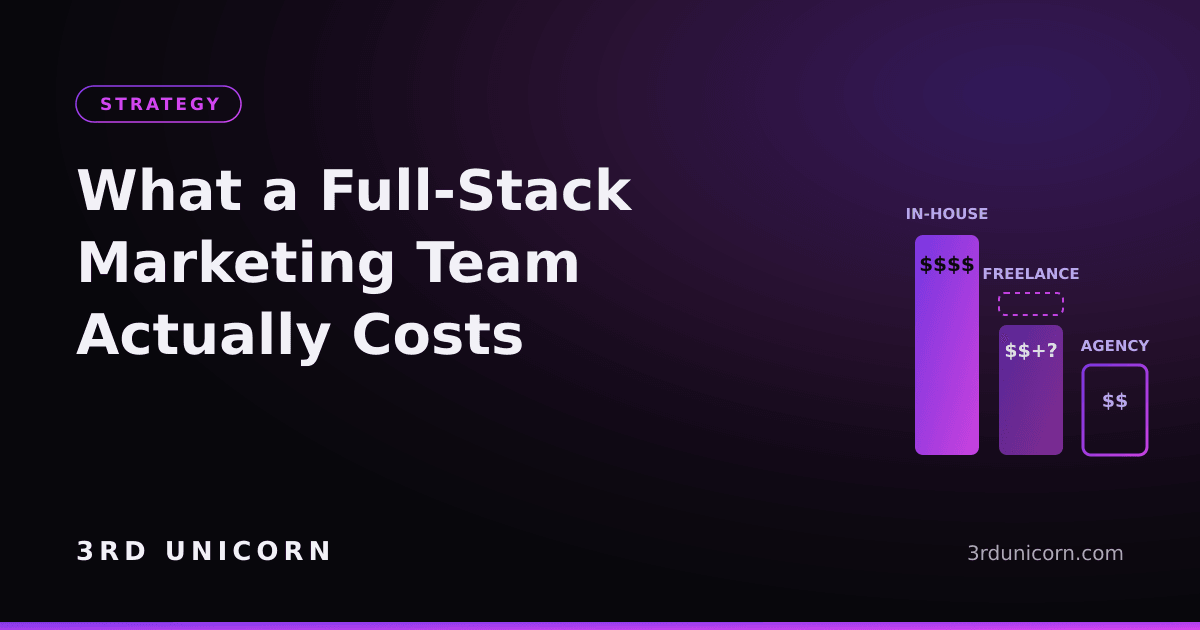
Every founder eventually does this math on a napkin: “We need SEO, content, design, video, paid ads and email. Do I hire, do I stitch together freelancers, or do I sign an agency retainer?” The napkin usually lies, because it only counts the visible number — the salary, the hourly rate, the retainer — and none of the machinery around it.
Here is the whole equation, with 2026 numbers, so you can run it honestly for your own company.
The in-house math: what a real team costs to own
A genuinely full-stack marketing function needs six core seats. Using typical 2026 US salary ranges (base only, mid-level to senior, national averages — coastal metros run higher):
- SEO lead — $85,000–$130,000. The person who owns rankings, technical health and the content-search connection. Good ones are scarce because every company finally wants one.
- Content writer/editor — $55,000–$85,000. Not “someone who can write” — someone who can write to search intent, hold an editorial standard and ship on a calendar.
- Designer — $60,000–$95,000. Brand, social, ads, landing pages. The seat that quietly gates every other seat’s output.
- Video editor — $55,000–$85,000. In 2026 this stopped being optional; every platform is a video platform now.
- Paid ads manager — $70,000–$110,000. Google and Meta both, ideally, plus the landing-page instincts to stop wasting the clicks.
- Email/lifecycle specialist — $60,000–$90,000. Flows, campaigns, deliverability, the CRM plumbing.
Add it up: $385,000–$595,000 a year in base salaries for the six seats. Then the parts the napkin forgets:
- Fully-loaded multiplier. Benefits, payroll taxes, equipment and office/remote stipends push true cost to roughly 1.25–1.4× base. Call it $480,000–$830,000 all-in.
- Tools. SEO platforms, design seats, video licenses, email platforms, analytics add-ons, project management: $2,000–$4,000 a month for a stack this wide, and it creeps upward every renewal.
- Management. Six specialists don’t manage themselves. Either a marketing director ($120,000–$180,000) or a meaningful slice of a founder’s week — the most expensive hours in the company.
Realistic total: $40,000–$75,000 per month for a US-based in-house full-stack function, before a single dollar of ad spend or link budget. (If paid search is in that plan, here is how we run Google Ads without waste.)
Geography swings this enormously — and honestly. The same six seats staffed in Western Europe run 20–35% less. Staffed in Eastern Europe, Latin America or South Asia, the salary line can fall 60–80% while the talent bar, at the top of those markets, stays genuinely world-class. That arbitrage is not a secret; it is the quiet engine behind half the agencies you have ever emailed. (It is also, transparently, our own model — a Dhaka cost base with output judged against Western standards. We simply publish the fact instead of hiding it behind a New York address.)
When in-house is right, it is right: full context, full control, compounding institutional knowledge. But it is a $500k-a-year commitment that takes six to twelve months to assemble and only pays off if you keep every seat busy — which brings us to everyone’s favorite shortcut.
The freelancer path: cheap per hour, expensive per outcome
Freelancers look unbeatable on paper. $30–$60/hour for solid mid-level talent globally, $80–$150/hour for genuine specialists, pay only for what you use. For a single, well-scoped job — a site migration, a batch of articles, a logo — a good freelancer is often the correct answer, full stop.
The trouble starts when freelancers become your system. Six disciplines means five to eight separate freelancers, and now you are paying costs that never appear on an invoice:
- The integration tax. Your SEO freelancer wants content the writer hasn’t been briefed on, targeting keywords the ads freelancer is already bidding on, for a landing page the designer delivered in a format the developer can’t use. Every handoff loses information, and you are the router. Founders routinely burn 10–15 hours a week routing — at founder opportunity cost, that alone can exceed an agency retainer.
- Quality variance. Freelance marketplaces are a lottery with a great top decile. You will re-do work. You will discover the “SEO expert” builds directory links. The vetting burden lands on the person least equipped to judge specialist work: the buyer.
- No strategy owner. Eight hired hands and nobody accountable for the number. Each freelancer optimizes their own deliverable; no one optimizes the system. When growth stalls, every individual report still looks fine — and that is precisely the problem.
- Availability drift. Freelancers rationally chase bigger clients. Your reliable editor disappears mid-quarter; your ads manager answers weekly now. Continuity is the thing you are not paying for, and it shows.
A realistic “full-stack via freelancers” budget lands around $3,000–$8,000 a month in fees for modest velocity — plus the router hours, plus the redo rate, plus the strategic drift that never shows up in a spreadsheet but always shows up in the year-end numbers.
The agency path: what the retainer actually buys
Agency pricing in 2026 spans a comedy of ranges, so anchor on the tiers:
- Boutique single-channel — $2,000–$5,000/month. One discipline done well (an SEO shop, a paid-ads shop). You still own integration across channels.
- Mid-market full-service — $5,000–$15,000/month. Multiple channels under one roof, a strategist attached, real reporting. This is where “one system” starts being true.
- Enterprise — $25,000/month and up. Named teams, SLAs, procurement-grade paperwork, and a meaningful share of your fee funding the account layer that manages you.
What a good retainer actually buys is not hours — it is the assembled system: specialists who already work together, management you don’t perform, vetted processes, tools amortized across clients, and one accountable owner of the number. You are renting the thing that costs $500k+ a year to build, for a twentieth of that, sooner.
What a bad retainer buys is a slide deck each month and a junior doing the work. The difference is rarely visible in the sales call and always visible in the itemization — which is exactly why we publish ours. Our full pricing is on the open web: campaigns from $999/month, every tier itemized down to what each dollar buys, and a public list of things we refuse to sell. For the full-stack case specifically, our Unicorn Lab bundle runs the four core programs — search, design, video, email — as one system for $2,999/month; the same four programs bought separately from us would cost about $3,196, and the honest pitch is not the discount, it is the single report with one number at the top.
For a deeper cost anatomy of one channel — including why the cheap version of a link is the expensive one — see our link building cost breakdown.
The decision framework, by stage
Pre-revenue or first revenue (budget under $1,000/month). Don’t hire anyone — including us. Pick the single channel your customers actually live in, learn it yourself or buy one well-scoped freelance project, and spend the rest of your attention on the product. Marketing multiplies demand; it cannot invent it.
Finding traction ($1,000–$3,000/month). One focused engagement beats three thin ones. A single-channel specialist — freelance or boutique agency — on the channel with proven pull. Measure ruthlessly. This is the stage where a $999 campaign with published deliverables is a rational buy and a $15k retainer is a rounding error away from malpractice.
Scaling ($3,000–$10,000/month). This is the fork. In-house still doesn’t pencil (one senior hire eats the whole budget), and freelancer sprawl is at its most expensive here. A full-service retainer or a bundled multi-channel program buys the assembled system at a fraction of building it. The test to apply: does the fee buy coordination — one strategy, one report — or just parallel deliverables?
Established ($10,000/month and up). Hybrid wins. Hire in-house where daily context compounds hardest — usually a marketing lead and possibly content — and keep specialist execution external where markets shift fast (search, paid, video). The in-house lead directs; the external bench executes; nobody pays $500k for capacity that sits idle between campaigns.
The hidden costs nobody prices
Whichever path you choose, the napkin still misses five lines:
- Hiring time. A senior marketing hire takes 60–90 days to find and close. Multiply by six seats. The vacancy cost — the growth not happening while you interview — never appears in any budget.
- Ramp-up. Every new hire, freelancer, or agency needs 30–60 days to learn your market before output is real. Plans that assume week-one productivity are fiction.
- Churn. Marketing roles turn over fast; agencies get fired and rehired; freelancers rotate. Every departure resets ramp-up, and in-house churn costs 50–100% of a seat’s salary per event once you count recruiting and lost momentum.
- Tool sprawl. Every person and vendor brings a stack. Six freelancers can mean six overlapping subscriptions billed to your card and three analytics setups that disagree with each other.
- Context loss. The most expensive one. Strategy that lives in one departed head, campaign history nobody documented, the “why” behind decisions evaporating at each handoff. Systems that write things down — ledgers, dashboards, documented playbooks — are worth real money precisely because of this line.
When you should NOT hire an agency
Honesty being the pitch, here is the list we give people on sales calls, verbatim:
- You haven’t found product-market fit. An agency can amplify demand signals; it cannot conjure them. Spend on the product and on talking to users.
- You can’t articulate a goal number. If neither of us can say what success looks like in a metric, the retainer buys motion, not progress. Fix the goal first — a strategy sprint or an audit is worth more than a retainer here.
- The budget only fits one channel done thinly everywhere. Spreading $1,500 across six services buys six failures. One channel done properly beats a full stack done homeopathically.
- You want hands on the keyboard daily. Some founders genuinely work best with an embedded person they can tap on the shoulder. That is an in-house hire, and the right agency will tell you so.
- You are shopping on guarantees. Anyone guaranteeing rankings or revenue is lying to you; leaving that fee in your pocket is a better investment than paying for a comfortable fiction.
The bottom line
In-house buys ownership at roughly $40k–$75k a month and six months of assembly. Freelancers buy flexibility and quietly bill you for coordination. Agencies buy an assembled system — genuinely, at the good ones, and theatrically at the bad ones — and the only reliable filter between the two is itemization: agencies confident in the math show the math.
Run the numbers for your stage before anyone’s sales narrative does it for you. And whatever you choose, choose one owner of the number — the most expensive marketing setup in the world is the one where results are everyone’s job and no one’s.
Want to see the assembled-system math with every line visible? Our pricing is public, itemized, and honest about what it’s not for.

Uchhash Akanda
Founder & CEO
Building 3rd Unicorn in public from Dhaka — specialist-first search programs, honest prices, and every lesson written down here.