
iGaming SEO · 12 min read
iGaming SEO Pricing: What Operators and Affiliates Actually Pay in 2026
Published · Updated · by Uchhash Akanda
Try to price iGaming SEO from public information and you’ll hit a wall almost immediately: agencies in this vertical publish case studies, badges and “book a call” buttons — never numbers. The opacity isn’t shyness. Quotes in this industry are priced per buyer, and a published rate card would end that game. We publish ours anyway, so consider this the article the vertical didn’t want written: what operators and affiliates actually pay in 2026, why the premium exists, and how to read a quote before you sign it. (If you first want to understand what the money buys mechanically, start with how iGaming SEO works.)
Why this vertical prices differently — the three multipliers
Publisher scarcity: roughly nine in ten say no. Run mainstream outreach and a healthy fraction of publishers will engage. Pitch iGaming content and watch acceptance collapse — editorial policies exclude the topic, ad networks that publishers depend on restrict it, and legal teams veto what editors would have accepted. In practice something like 90% of the general-web publisher pool is simply unavailable. The tenth that remains knows exactly what that scarcity is worth, and prices accordingly. Every other number in this article flows downstream from this one fact. For comparison, what the same links cost outside this vertical is a useful baseline.
Compliance overhead. Every market has rules about what a page may claim and how offers are worded; multi-market brands multiply that by every licence they hold. Content in this vertical is written, reviewed and sometimes lawyer-checked — a cost layer mainstream SEO simply doesn’t carry. Agencies that do it properly staff for it; agencies that don’t produce rankings that a compliance review later dismantles.
Competitor sophistication. The first page of any commercial iGaming SERP is occupied by companies spending five to six figures a month on search, defended by teams who have been doing this for a decade. You aren’t paying an agency to do SEO; you’re paying it to out-execute the most experienced SEO buyers on the internet. That expertise premium is real, and worth paying — once, to the right vendor.
The real price bands in 2026
Placements: $150–$600+ per link. Genuine iGaming-accepting publishers with real organic traffic quote in this band for standard markets, and the upper end climbs past $1,000 for premium industry titles. Two things push a placement up the band: market match (a publisher whose audience is actually in your target country) and language match (native-language editorial in that market’s tongue) — matched placements routinely carry a 50–100% premium over generic English inventory, because matched supply is the scarcest thing in an already scarce market. For calibration: our iGaming placements start at $249, with market- and language-matched inventory from $399, quoted per market within 24 hours.
Specialist boutiques: $5,000–$20,000+/month. The named-brand iGaming SEO shops — the ones speaking at industry conferences — quote five figures monthly, often with six-month commitments and onboarding fees. What you’re buying is genuinely scarce: deep publisher networks, market-by-market experience, teams who’ve survived every update in the vertical. What you’re also buying, at the top of the band, is conference sponsorships and account-management layers. Some of that money ranks you; some of it brands them.
Generalists who quietly subcontract: $2,500–$7,500/month. A large share of “we do iGaming too” agencies at standard US retainer prices don’t have iGaming publisher relationships at all — they buy your links from the same specialist wholesalers you could buy from directly, add margin, and wrap a report around it. The tell: they can’t answer market-specific questions in the first call, and their quotes never itemize placements. You pay generalist prices for brokered inventory and a delay.
Where we sit: iGaming programs from $2,499/month. Specialist scope — vetted vertical publisher network, compliance-aware content, the anchor and velocity discipline from the iGaming link building playbook — at a Dhaka cost base instead of a conference-circuit cost base. That’s the whole trick, and it’s the same trick across our rate card: you pay for the filter, the network and the strategy, not the office.
Market-tier economics: where you compete changes what you pay
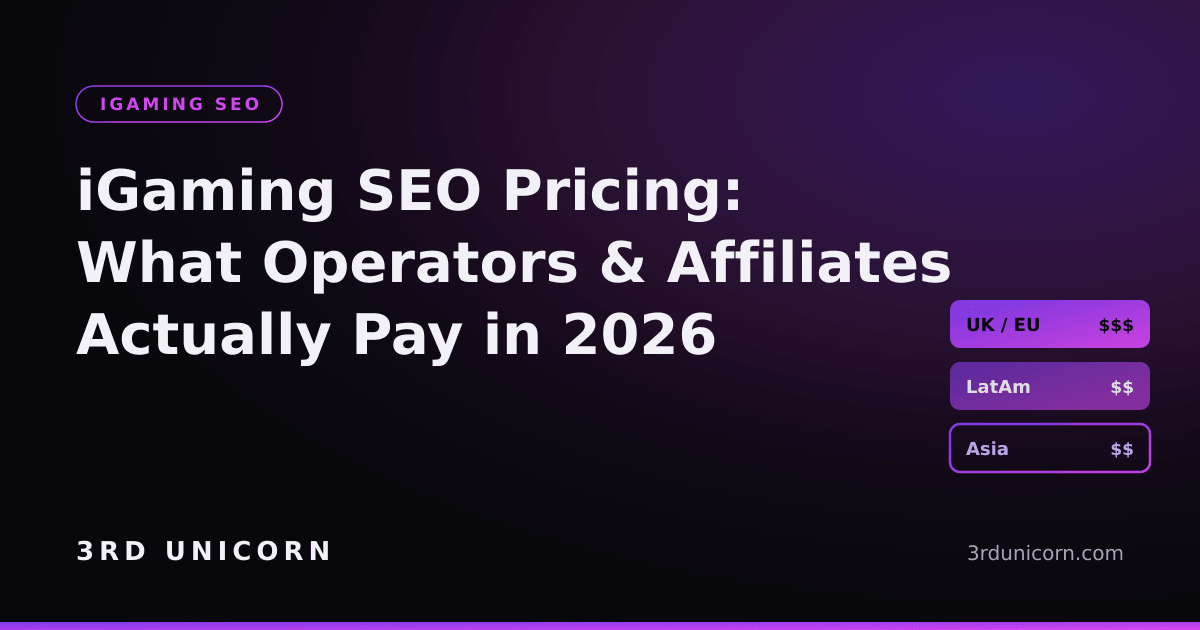
Mature markets (UK, Western EU, Nordics). The deepest publisher pools — and the most expensive ones, because every operator wants the same inventory. Placements price at the top of the band, content must clear the highest compliance bar, and SERP incumbents are fortified. Budgets here start meaningful: realistic programs run mid four figures monthly and the payback horizon is longer — but the traffic, once won, is the most valuable in the industry, and rankings in mature markets defend well because the moat you crossed now protects you.
Emerging markets (LatAm, parts of Asia, Africa). Thinner publisher pools but far less competition for them; placements often cost less in absolute terms, though matched inventory (local language, local audience) can be scarce enough to carry mature-market prices. The economics invert: smaller budgets move rankings faster, payback arrives sooner, but the traffic monetises lighter and regulatory ground shifts more often. The winning pattern we see: establish in one emerging market on a moderate budget, bank the cash flow and the domain authority, then spend both crossing into a mature market.
The practical point for buyers: a quote that doesn’t ask which markets you’re targeting isn’t a quote — it’s a template. Market determines publisher pool, language requirement, compliance bar and competitor spend. Any serious vendor prices per market; that’s why our own placements are quoted per market in 24 hours rather than flat-rated.
What an iGaming SEO quote should itemize
The quotes worth signing share one property: you can see the parts. Demand line items for —
- Placements: count per month, grade/quality bar per placement, market match specified, per-unit cost stated.
- Content: pieces per month, word counts, who writes (vertical experience matters here more than anywhere), compliance review included or not.
- Technical scope: what’s owned (crawl fixes, hreflang for multi-market, site health) vs what’s advisory.
- Strategy and management hours — as their own line, so you can see what the thinking costs.
- Reporting: what you’ll see monthly, and whether you’ll see every placement URL (you should — non-negotiable).
The fog-quote red flags, all of which we’ve seen this year: a single “SEO retainer” line with no decomposition; “proprietary network” as a reason you can’t see placement URLs; guarantees of rankings in a vertical where nobody controls the SERP; onboarding fees larger than month one’s deliverables; and contracts whose exit clause outlasts their delivery schedule. Every one of these is the sound of margin hiding. Our pricing page states the itemization promise as policy — every custom quote arrives as a line-itemized sheet — because in a fog market, the sheet is the differentiator.
Budget-by-goal framework
New brand entering the vertical — $2,500–$5,000/month. You’re buying foundations and patience: technical excellence from day one, branded-anchor authority building at conservative velocity, content architecture for one or two markets, and six months of discipline before commercial terms move. Under ~$2,500/month in this vertical, velocity drops below what the SERP requires and the program stalls — better to wait and enter properly than to enter thin.
Established operator defending and expanding — $5,000–$15,000+/month. Brand-defence SERPs, market-by-market landing infrastructure, PR-driven authority spikes around launches, and enough placement velocity to match incumbent competitors market by market. At this level the constraint isn’t budget efficiency; it’s vendor capacity and publisher access — ask any prospective agency how much matched inventory they can actually deliver monthly, per market, before you sign.
Affiliate site — $1,500–$8,000/month, stage-dependent. Affiliates live and die by rankings, so the budget question is really a portfolio question: early sites spend like new brands (foundation-heavy, anchor-conservative); proven sites scale placement velocity into the markets whose payouts justify it. The affiliate-specific trap is over-anchoring young domains to money terms — the fastest way to turn a $30k investment into a burned domain, which brings us to the last section.
Why cheap is the most expensive option here
In mainstream niches, a bad link is wasted money. In iGaming, it’s often negative money, because the vertical is graded on Google’s most sceptical curve. The $80 “iGaming placement” from a marketplace sits on a farm that took the scarcity premium as an invitation to manufacture supply; enough of those and a young domain doesn’t underperform — it gets classified, and everything else you build is suppressed with it. A burned domain in this vertical costs its full history: the registration, the content, the legitimate links, the months. Wasted anchors compound the same way — exact-match blasts that a mainstream site might dilute quietly are, on an iGaming domain, the loudest possible confession.
Run the surviving-link math with vertical numbers: $400 of cheap placements that die or damage vs $500 on two vetted, matched placements that compound. The “expensive” option is cheaper in every year except the one where you signed. That’s the entire economics of specialist iGaming SEO in one sentence: in a market where mistakes are this costly, the filter is the product.
The bottom line: iGaming SEO prices high because nine-tenths of the publisher market is closed, compliance rides on every asset, and your competitors are professionals. Expect $150–$600+ per genuine placement, five figures monthly at the boutiques, and be suspicious of both extremes — the generalist who’s really a broker and the bargain that’s really a farm. Buy per-market, demand itemization, and judge every vendor by the only question that matters here: show me the network, show me the vetting, show me every URL.
Want a market-by-market quote you can actually read? Tell us your targets — the itemized sheet arrives within 24 hours, honest about what your SERP requires.

Uchhash Akanda
Founder & CEO
Building 3rd Unicorn in public from Dhaka — specialist-first search programs, honest prices, and every lesson written down here.
Related reading