
Link Building · 10 min read
Anchor Text Strategy for New Domains: Why Exact-Match Is a Trap Early On
Published · Updated · by Uchhash Akanda
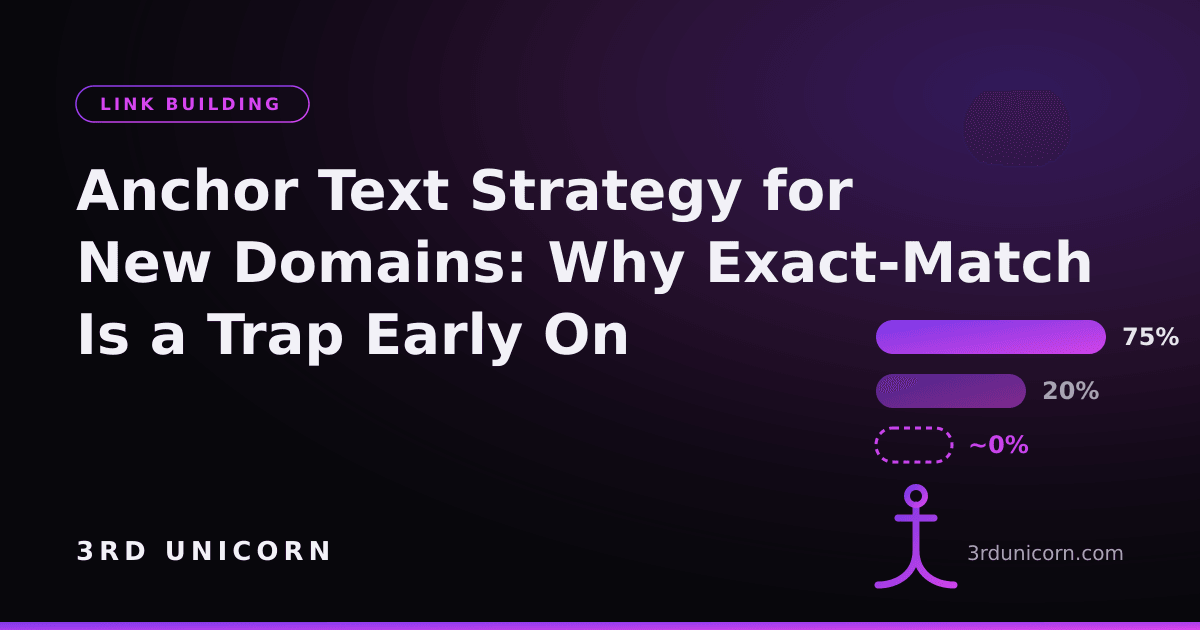
Ask a room of marketers what anchor text to use and half will say the keyword they want to rank for. It sounds logical: anchors describe the destination, Google reads anchors, so point the phrase you’re targeting at the page you’re targeting. On a domain with years of history and thousands of links, a little of that is survivable. On a new domain, it’s the single fastest way to make an otherwise clean link profile look bought — because, statistically, it almost always is.
Here’s the mechanism, the ratios, the math for fixing a profile that’s already skewed, and a month-by-month anchor plan you can copy for any new domain.
What an anchor profile actually signals
Every link to your site arrives with a label — the anchor — and in aggregate those labels form a fingerprint of how the web talks about you. Google has been reading that fingerprint since PageRank was a thesis, and it has two decades of base rates for what organic referencing looks like.
When people link to a site naturally, they overwhelmingly do it by name. They write “according to 3rd Unicorn”, or paste the bare URL, or link a whole sentence, or use lazy generics like “this study” and “read more”. What they almost never do — spontaneously, at scale — is link to a commercial landing page using the precise phrase that page targets in search. Real humans don’t talk in keywords. Buyers of links do.
So an anchor profile is best understood as a claim: this is how the internet refers to me. Established brands can plausibly claim some keyword-shaped references — they’ve been written about for years, journalists describe them by what they do, some natural partial-matches accrue. A domain registered five months ago claiming that 30% of the web refers to it by its money keyword is making a claim with no plausible explanation except invoice.
Why exact-match is a trap specifically for new domains
Three compounding reasons:
1. There’s no history to hide in. On a mature profile with 800 referring domains, ten new exact-match anchors move the ratios by around a percentage point. On a new domain with 25 links, the same ten anchors are the profile — 40% commercial anchors, an outlier against every natural base rate Google holds.
2. New-domain scrutiny is already elevated. Fresh domains ranking quickly for commercial terms is the exact shape of every churn-and-burn scheme the spam team has ever fought — in aggressive verticals like iGaming, doubly so. A young site is graded on a curve, and the curve is sceptical. Exact-match anchors are the loudest possible answer to the question “is this site earning or buying its position?”
3. The trap is asymmetric. The upside of an early exact-match anchor — a small relevance boost you could have earned later anyway — is minor. The downside is a devalued profile or a link-spam classification that suppresses everything else you build for months. You’re risking the whole account to skim a little interest.
The four buckets — and how ratios should shift with age
Classify every anchor into four buckets: branded (“3rd Unicorn”, “the 3rd Unicorn team”), URL (“3rdunicorn.com”, “https://3rdunicorn.com”), topical/natural (“this breakdown of publisher vetting”, “a growth agency”, “read more”), and commercial — partial-match (“iGaming SEO specialists”) through exact-match (“iGaming SEO agency”).
Working targets that hold up in practice:
| Domain age | Branded + URL | Topical / natural | Partial-match | Exact-match |
|---|---|---|---|---|
| 0–6 months | 70–80% | 15–25% | 0–5% | ~0% |
| 6–18 months | 60–70% | 20–25% | 5–10% | 1–3% |
| 18+ months, established | 50–60% | 20–30% | 10–15% | 3–5% |
Two refinements that matter more than the table itself:
- Ratios are per-page, not just per-site. A sitewide profile can look pristine while one money page quietly accumulates 60% commercial anchors — and pages get evaluated too. Track your top commercial pages individually; a money page above roughly 25–30% commercial-intent anchors is due a branded-only cool-down regardless of what the site-wide number says.
- The exact-match column is a ceiling, not a quota. Nothing requires you to reach 5%. Plenty of pages rank #1 for competitive terms with almost no exact-match externals at all, carried by topical authority and internal anchors — which is where the free lever comes in below.
The dilution math (why prevention is 5x cheaper than cure)
Anchor ratios are a fraction, and you can only fix a fraction from two directions: remove numerator or grow denominator. Removal is slow and unreliable (publishers ignore edit requests), so in practice you fix profiles by dilution — and the arithmetic is brutal enough to memorise:
Say a young domain has 40 referring domains, 8 of them exact-match — 20% exact, well into audit territory. Target: get under 8%.
8 ÷ x = 0.08 → x = 100 total referring domains.
You need 60 new links — every one branded, URL or natural — to dilute 8 bad anchors down to a defensible ratio. At restricted-vertical placement prices, that’s five figures of remediation spend to neutralise what was probably a few hundred dollars of “aggressive” anchors. Prevention isn’t a best practice; it’s a 5-to-1 cost avoidance.
The same math explains why early discipline compounds: a domain that reaches 100 links with 2 exact-match anchors can afford the occasional commercial anchor later. Its denominator absorbs them.
The anchor ledger: the boring practice that prevents all of this
Teams don’t drift into over-optimisation because they’re reckless; they drift because nobody is counting. The fix is a spreadsheet — the anchor ledger — and ten minutes a month:
- One row per acquired link: date, referring domain, target page, anchor text, bucket (branded / URL / topical / partial / exact).
- One pivot per money page: bucket percentages, updated as placements land.
- One rule: the next batch’s anchors are chosen by looking at the ledger, not at the keyword map. If a page is drifting commercial, the next five links to it are branded, full stop.
Every serious operation we’ve audited that had clean anchors had some version of this ledger. Every over-optimised profile we’ve cleaned up had none. The correlation is not subtle — we walked through the vertical-specific version of this discipline in the iGaming link building playbook.
Internal links: the free anchor lever almost everyone ignores
Here’s the asymmetry that makes early-stage anchor strategy much less painful than it sounds: internal anchors are not graded on the same curve. Your own site linking “iGaming SEO services” from a blog post to your service page is normal information architecture — descriptive internal anchors are what good sites do, and Google’s own guidelines encourage them.
So the working pattern for a young domain is a division of labour:
- External links: branded and URL anchors, earning trust — the profile a real brand accrues.
- Internal links: descriptive, keyword-bearing anchors from every relevant article to the money pages — supplying the relevance signal the externals deliberately don’t.
A domain with 30 branded external links and a dozen well-anchored internal links from genuinely useful posts typically outranks the same domain with 30 exact-match externals — and carries none of the risk. This is also the structural reason content clusters work: every new post is another safe, controllable anchor pointing at the pages that earn revenue.
Fixing an over-optimised profile — without touching disavow
If you’ve inherited or built a skewed profile, work the levers in this order:
- Stop the bleeding. Freeze all commercial anchors immediately — the ledger’s cool-down rule. Every in-flight placement switches to branded.
- Dilute deliberately. Run the math above for each affected page, set the target link count, and acquire branded/URL/natural links until the ratio clears — prioritising the pages closest to their next ranking opportunity.
- Edit where relationships allow. For placements you bought from responsive publishers, request an anchor change to branded. Expect a 20–40% success rate; take it — every edit is one less link to dilute.
- Re-aim deep links. Some over-anchored links point at pages that no longer matter. If the target page can be consolidated or redirected into a hub, the anchor’s weight redistributes and the per-page ratio problem dissolves.
- Leave disavow alone. Disavow is for manual actions and genuinely toxic link attacks — not for anchors you built too aggressively. Disavowing working links to fix a ratio burns equity you paid for; dilution fixes the ratio and keeps the equity. In several years of cleanups we’ve needed disavow in only a handful of genuinely adversarial cases.
Vetting the publishers behind those links is its own discipline — the auditor’s checklist covers it — because dilution links from farms don’t dilute anything; they just add a second problem.
The copy-paste anchor plan: a new domain’s first six months
Assume a fresh domain, one or two money pages, a starting blog. Adjust volumes to your market’s velocity benchmarks; keep the shape:
Months 1–2 — identity only. 100% branded + URL anchors (“3rd Unicorn”, “3rdunicorn.com”), pointed at the homepage and one cornerstone article — not the money pages. Publish the first content cluster; internal-link it with descriptive anchors. Months 3–4 — breadth. ~80% branded/URL, ~20% topical/natural (“this guide to publisher vetting”), first links pointed at deep content pages. Money pages still receive only internal anchors. Month 5 — first commercial touch. Introduce partial-match sparingly — one or two anchors like “iGaming growth specialists” on strong placements, aimed at a money page that already ranks on page 2–3 from internal signals. Ledger check before and after. Month 6 — review, don’t escalate. Pull the ledger: site-wide commercial share should still be under ~5%, no single page above 15%. If rankings are moving, change nothing — velocity and consistency are doing the work. If a page is stuck, the fix is almost never “harder anchors”; it’s more supporting content and better placements.
Run that shape for two or three quarters and you build the profile that makes everything afterwards cheaper: a domain whose history earns it the right to the occasional commercial anchor — the position every aged competitor you envy started from. It’s the same sequencing we run inside full iGaming SEO programs, where anchor discipline is a survival requirement, and it’s half of what clients are actually buying from a link building service worth the name: not links — judgement about what each link should say.
The bottom line: anchors are claims, new domains have no history to make big claims with, and exact-match early is a claim with only one plausible explanation. Spend your first six months building the boring branded profile of a real business, let internal links carry the keywords, count everything in a ledger — and you’ll never need to learn the dilution math from the expensive side.
Not sure what your anchor profile is claiming right now? Send us your domain — we’ll run the ledger on your top pages and tell you honestly what Google sees.

Uchhash Akanda
Founder & CEO
Building 3rd Unicorn in public from Dhaka — specialist-first search programs, honest prices, and every lesson written down here.