
Link Building · 10 min read
What the Backlink Data Shows: 137 Paid Links, Audited
Published · Updated · by Uchhash Akanda
Most writing about link quality is written from the outside. Someone reads a marketplace listing, quotes an authority score, and calls it a premium placement. Nobody opens the page source. Nobody checks whether the publisher’s own traffic still exists. Nobody asks how many of the “links” in a backlink report are actually the same article counted several times.
This is the inside view. Over the past week we pulled the page-level backlink data from three crypto media publishers — CCN, Cryptopolitan and Coinspeaker — to six crypto-facing iGaming brands that had bought heavily from them, and read every link. The publishers were chosen because all three had lost more than 90% of their organic traffic between September 2025 and February 2026. The brands were chosen because they were the biggest buyers. What follows are the numbers, what they mean for anyone paying for placements in this vertical, and — because a sample of three and six is a sample, not a census — exactly how far you should trust them.
What did we actually measure?
Three inputs, all from a third-party SEO tool that estimates traffic rather than measuring it directly — an important limit we come back to at the end.
First, the publishers’ own organic traffic curves over the past two years. Second, the page-level backlinks from those three domains to each of the six brands: every URL, its rel attribute, its first-seen date, and where it actually resolves. Third, the publishers’ prior sales into this vertical, counted from their own archives: Cryptopolitan had sold 151 iGaming placements before the fall, CCN 38, Coinspeaker 4.
Reading each link individually is the part nobody does, and it is the part that produced every finding below. A backlink export is a list of claims. Opening each one turns it into evidence.
What happened to the three publishers?
All three followed the same shape: a steep decline beginning in the autumn of 2025 and bottoming out by February 2026, each finishing more than 90% below its previous organic traffic. That is not a dip. That is a site search engines have stopped sending people to.
Two pieces of context sit around that. In November 2025, Cointelegraph — the largest publication in the same space — saw its traffic drop and removed its iGaming section entirely, in a pattern reported as a manual penalty landing weeks after a spam update. Separately, Google search traffic to news sites in general fell by roughly a third worldwide over the past year. So part of what hit these publishers was weather that hit everyone. But a third and a ninety-percent loss are different events, and the sites that lost ninety were the ones carrying the heaviest paid-placement inventory in a vertical Google scrutinises harder than almost any other.
We are not going to claim causation from three data points. We are going to note that the correlation is exactly the one an auditor would expect, and move on to what the links themselves say.
Was the “premium placement” ever passing value?
This is the first finding, and the one with the most money attached.
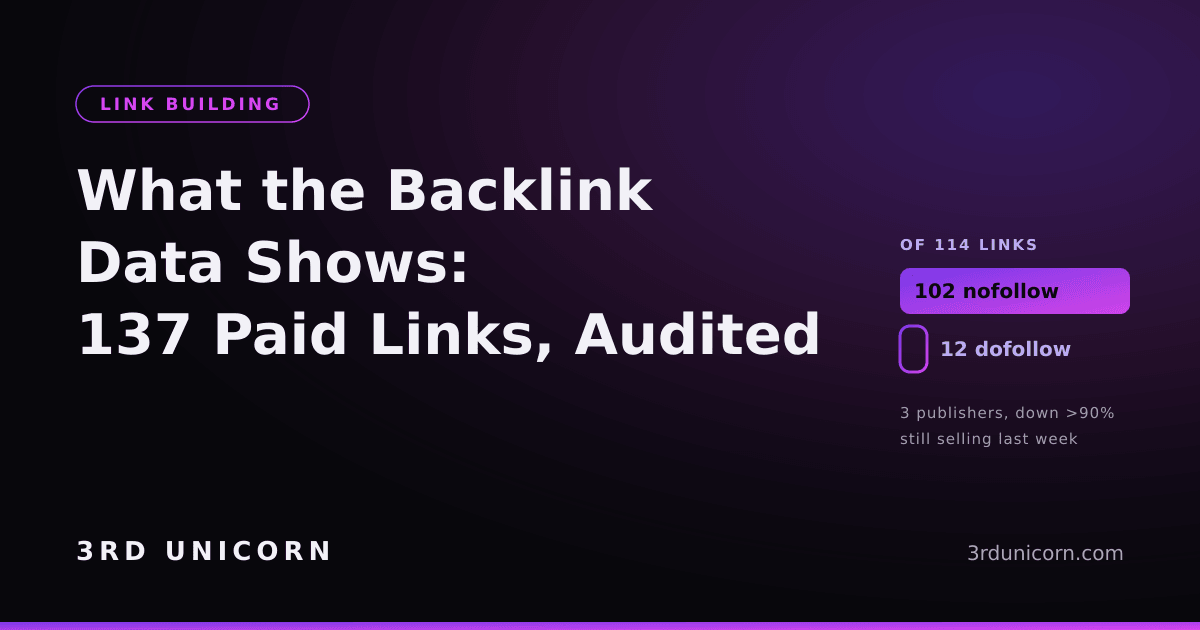
The largest of the six brands had 114 links from the three publishers. 102 of those 114 carried rel=nofollow. Around 75 of them also carried rel=sponsored on top. Across all six brands, every single link from CCN and from Cryptopolitan was nofollow — not one dofollow link between them, from two publishers that had sold 189 placements into this vertical between them.
Sit with that for a second. Those placements were sold, presumably, as editorial links on high-authority crypto media. Buyers paid what that description costs, which in this vertical is a multiple of mainstream rates. And the markup on the page — the only thing search engines actually read — said do not count this.
The point is not that nofollow links are worthless. They can send referral traffic; they carry brand visibility; Google treats the attribute as a hint rather than a wall. The point is that they are a different product from the one on the invoice. If you buy a ranking asset and receive an advertisement, the difference between those two prices is the amount you overpaid — and nothing in the transaction surfaces it. The listing does not say nofollow. The rate card does not say nofollow. The invoice looks identical either way. The only place the truth lives is in a rel attribute that most buyers never open.
We have argued before that vetting a publisher takes fifteen minutes. Checking the rel attribute on a comparable live placement takes thirty seconds, and in this sample it would have reclassified 89% of the largest brand’s links before a dollar moved.
Do publishers keep selling through a collapse?
Second finding, and the one that changes how you should think about the seller across the table.
Only 12 dofollow links existed in the entire 137-link set. All 12 sat on one publisher’s Portuguese-language editorial pages, and all 12 pointed at a single brand. Their first-seen dates were 9 and 10 September 2026 — last week, as we write this. That is a publisher nine months into a 95% traffic decline, still selling editorial dofollow placements to a brand that was still buying them.
The same pattern shows up in a stranger shape elsewhere in the data. A DR-9 domain with no measurable traffic received 191,406 sitewide footer links from one of the collapsed publishers, first seen on 5 August 2026 — a site that had already lost its audience, wiring its entire template to a domain with none of its own.
Neither of those is a scandal. Both are exactly what the incentives predict. A publisher is paid on placement, not on outcome; its rate card does not fall when its traffic does, because most buyers never look at the traffic. The seller’s incentive is to keep selling for as long as anyone keeps paying, and the buyer’s incentive is to stop paying the moment the asset stops working — and there is no mechanism in an ordinary link purchase that connects those two facts. The traffic graph is not on the order form. It has to be checked, per publisher, per order, by the buyer. We covered how that check works inside a broader program in how iGaming SEO works; the short version is that a placement on a site down 95% is a placement on a site search engines have already stopped visiting, whatever the domain metrics still say.
How inflated are link counts?
Third finding, and the one that quietly undermines the number everyone reports.
“137 links from three top crypto publishers” sounds like a serious footprint. Reading them one by one, it dissolves.
Translation multiplies. One brand’s entire footprint on one publisher was a single article from April 2025, translated into four languages and reported as four separate links. One editorial decision, one placement, four rows in the export.
Redirects count as links that pass nothing. Five of one brand’s seven links were cloaked affiliate redirects — the visible URL was on the publisher, but it resolved through a 302 or 301 via a third-party domain before reaching the brand. A backlink tool records the publisher page as linking to the brand. Nothing flows along that path that a search engine would credit to the destination.
Sitewide templates explode the numbers. The 191,406 footer links above are one decision — put this link in the footer — counted once per page it appears on.
Strip out translated duplicates, cloaked redirects and template repetition, and the 137-link footprint reduces, in substance, to a few dozen genuine placements. The tool was not wrong; it counted URLs faithfully. But a URL count is not a placement count, and a placement count is not a value count. Every layer between the number in the report and the value on the page is a place where money quietly disappears.
What does this change for a buyer?
Four things, each of which we now run before any placement in this vertical, and each of which you can run yourself.
- Check rel= before paying. Ask for a live comparable placement and view its source. If it says nofollow or sponsored, price it as advertising. In this sample that single check would have reclassified 102 of 114 links.
- Check the page, not the domain. Where does the link actually resolve? A redirect through a third-party domain is not a link to you. A translated duplicate is not a second link. Open it.
- Check whether the publisher’s own traffic is falling. Pull the organic curve for the last two years. A site down 90% is not a premium placement at any price, and its rate card will not tell you.
- Treat a link count as a claim, not a fact. “137 links” is what the tool said. “A few dozen placements, mostly nofollow, some still being sold mid-collapse” is what the pages said. Only one of those is worth paying for.
None of this is complicated. All of it is skipped, routinely, because the number on the marketplace listing is easier to read than the page behind it. That gap between the listed number and the audited one is where this vertical’s fake inventory lives, and it is the reason our link building work publishes its vetting gates rather than a price-per-DR menu — the gates are the product.
How far should you trust these numbers?
Honestly stated: this is three publishers and six brands. It is a deliberately narrow sample, chosen because the publishers had visibly collapsed and the brands were heavy buyers, which makes it a good place to look for the pattern and a bad basis for a market-wide percentage. The traffic figures come from a third-party SEO tool, which estimates organic traffic from ranking data rather than reading analytics; the direction and scale of the declines are not in doubt, but the exact percentages carry the tool’s error bars. First-seen dates are the tool’s crawl dates, which lag reality by days to weeks. And rel attributes and redirect chains were read from the live pages at the time of the audit — a publisher could change either tomorrow.
What the sample can support: that nofollow-by-default is the norm rather than the exception at these three publishers, that selling continued well after collapse, and that reported link counts materially overstate real placements. What it cannot support: a claim about every publisher, or every brand. Check your own suppliers against the same four questions before you generalise from ours.
The reason we publish audits like this at all — alongside the case studies where the same discipline was applied to our own clients — is that the vertical runs on numbers nobody verifies. Verification is cheap. Skipping it is not.
If you’d like your current placements read the way we read these — link by link, rel attribute by rel attribute — send us the list. The first reply tells you how many of them are what you paid for.
Frequently asked questions
Are paid placements on crypto media sites usually dofollow?
In the sample we audited, no. Of 114 links from three major crypto publishers to the largest iGaming brand, 102 carried rel=nofollow and roughly 75 also carried rel=sponsored. Two of the three publishers had not published a single dofollow link to any of the six brands. Assume nofollow until you have seen the markup yourself.
How do I check whether a link is nofollow before I pay for it?
Ask the publisher for a live example of a comparable placement, open it, and view the page source. Look at the rel attribute on the link itself, not the domain. If the seller cannot produce a live example, or the example carries rel=nofollow or rel=sponsored, price the placement as brand exposure only, not as a ranking asset.
Does a nofollow or sponsored link have any SEO value at all?
It can bring referral traffic and brand visibility, and Google treats nofollow as a hint rather than a hard block. But it is not what buyers are paying premium rates for. If the invoice assumes ranking equity and the markup says sponsored, you have bought advertising at link-building prices — a legitimate product, priced as a different one.
Why would a publisher keep selling links after its traffic collapsed?
Because the seller is paid on placement, not on outcome. A publisher nine months into a 95% traffic decline still has an inventory page, a rate card and a sales inbox, and nothing in a normal transaction shows the buyer the traffic graph. The incentives run in opposite directions, so the burden of checking sits entirely with the buyer.
Why do backlink tools report more links than actually exist?
Tools count URLs, not placements. One article translated into four languages is reported as four links. A cloaked affiliate redirect that passes through a third-party domain is reported as a link even though nothing flows to the target. In our sample, a 137-link footprint reduced to a few dozen genuine placements once those two effects were stripped out.
Is this audit representative of the whole iGaming link market?
No, and it does not claim to be. It covers three publishers and six brands — a deliberately narrow sample chosen because the publishers had collapsed and the brands were heavy buyers. The traffic figures come from a third-party SEO tool, which estimates rather than measures. Treat the findings as a pattern worth checking against your own suppliers, not a market census.

Uchhash Akanda
Founder & CEO
Building 3rd Unicorn in public from Dhaka — specialist-first search programs, honest prices, and every lesson written down here.
Related reading
Anchor Text Strategy for New Domains: Why Exact-Match Is a Trap Early On
10 min read
Link BuildingiGaming Link Building: How to Earn Editorial Links in a Restricted Vertical
11 min read
Link BuildingHow to Vet a Guest Post Publisher Before You Pay (The Auditor's Checklist)
10 min read